
A Dollar That Helped Build a Monument: The Bowe Family and the Washington Monument
As a trained museum curator, I’m accustomed to finding history in unexpected places. Early in my museum career, I focused on objects and how they shaped and reflected people’s lives. That curiosity was first sparked in antique stores—a place I spent a great deal of time while growing up in a family of collectors—where a single object could prompt questions about its use, ownership, and journey through time. When working with archives, such as those held by the American Pomeroys, that curiosity takes a different form. At the core of my professional background are history, primary-source research, and writing, a foundation that aligns closely with my museum training and directly informs my work today as the American Pomeroys’ Archivist.
Much of the work my team and I do happens behind the scenes, through projects that improve access to our own collections while opening new avenues of research for others studying the Pomeroy and allied family lines. Since last fall, we have been processing the Bowe Family Collection, connected to the great-great-grandparents of our organization’s founder. A significant portion of this work has focused on one individual in particular: James Edgar Bowe, whose travels took him from Ohio to California and back again, as well as overseas to England. His life story closely mirrors many defining themes of the mid-nineteenth-century United States, including westward expansion, the Gold Rush, and the development of banking and commerce. Once fully compiled and contextualized, his story will be shared in greater detail by our transcription and extraction specialist.
At the same time, intensive work on James Edgar Bowe’s materials prompted a broader re-examination of the entire collection. Like many archival accessions, the Bowe Family Collection arrived with limited original order, and earlier attempts at organization had left several groupings of documents only partially processed. The renewed research focus allowed the collection to be chronologically reorganized for the first time in years, revealing materials related to other members of the Bowe family. What emerged was a richer and more complex body of records documenting investments, land transactions, correspondence, and death records.
Among these materials, one document stood out—not as an investment record, but as an unexpected connection between the Bowe family and a national monument. Erastus Guilford Bowe, born circa 1818 (with records variously citing April 5, September 5, or occasionally 1817), spent most of his life in and around Tiffin, Seneca County, Ohio. Unlike his brother James Edgar Bowe, whose travels were far-reaching, Erastus remained close to home throughout his adult life.
On September 25, 1842, Erastus Guilford Bowe married Mary Elizabeth Hart (no known relation). He held a variety of occupations in Seneca County, primarily in Tiffin, and appears to have achieved a measure of financial stability through business and land dealings. Sometime between 1833 and 1854, Erastus donated one dollar to the Washington National Monument Society—an amount roughly equivalent to forty-two dollars today, and a meaningful contribution for the period.
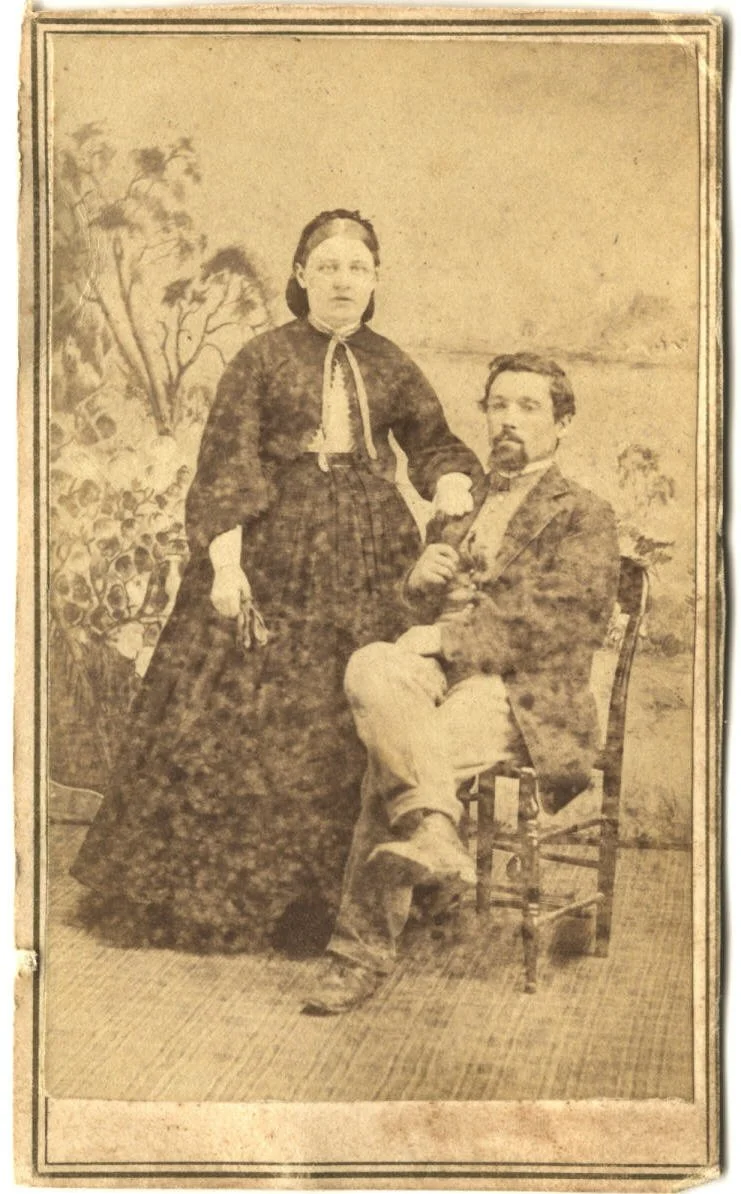
Erastus Guilford Bowe married Mary Elizabeth Hart
The history of the Washington Monument itself is both fascinating and fraught. In 1833, the Washington National Monument Society was formed with the goal of commemorating George Washington through a monumental structure. For more than a decade, the Society solicited designs and financial support before selecting architect Robert Mills’s ambitious design in 1845.[1]
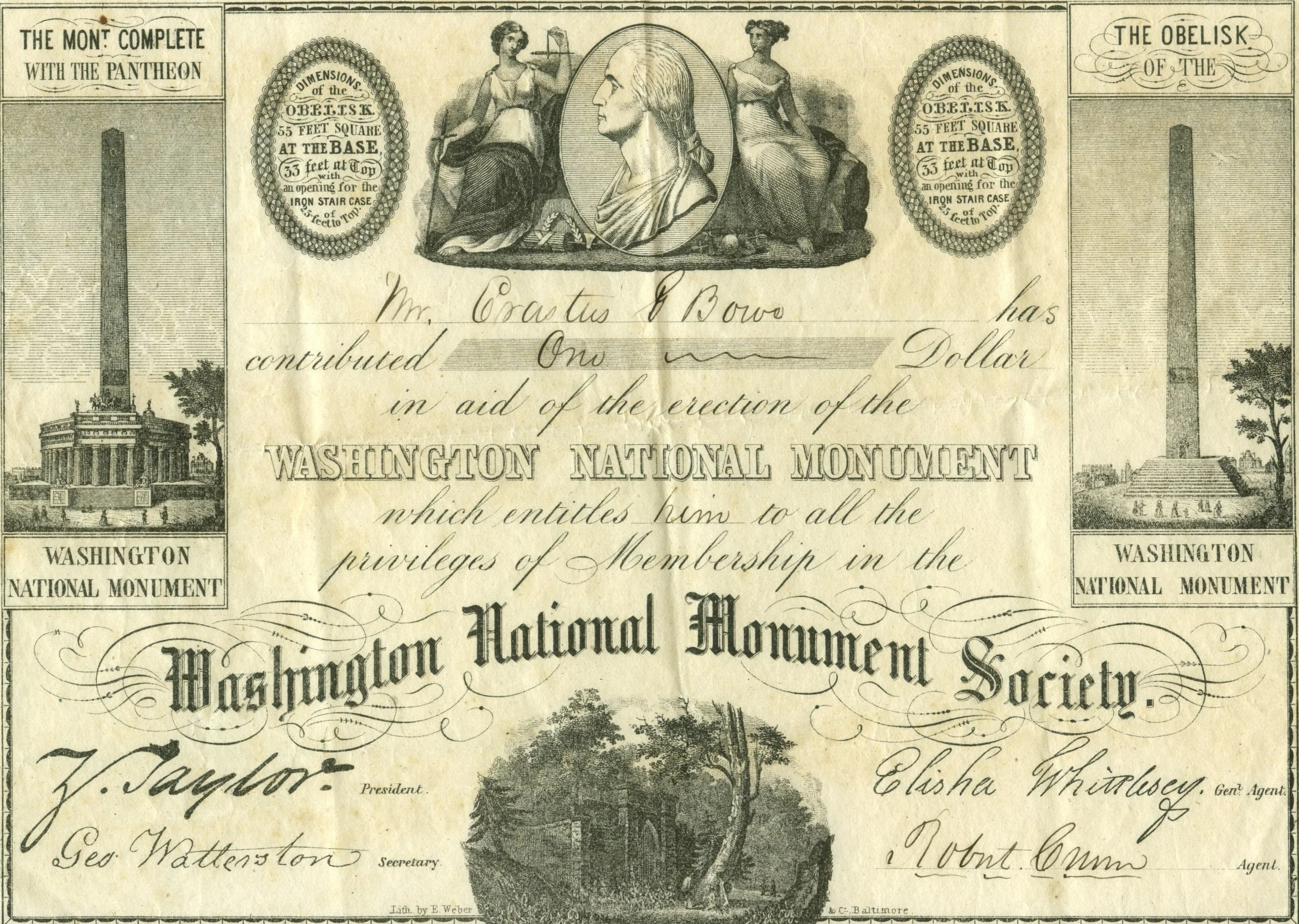
Erastus G. Bowe Contribution Certificate to Washington Monument
On July 4, 1848, the monument’s cornerstone was laid before a crowd estimated at more than 20,000 people. Mills’s original design was elaborate and far removed from the monument’s final appearance. Persistent fundraising challenges, combined with significant changes in the Society’s leadership, led to bankruptcy by 1854 and brought construction to a halt. The unfinished structure stood throughout the Civil War and was largely neglected until 1876, when Congress assumed responsibility for the project under the supervision of the U.S. Army Corps of Engineers. Structural concerns stemming from earlier cost-cutting measures had to be addressed before construction could resume.[2]
Design revisions continued as work progressed, largely driven by financial constraints, until the monument reached its present form in December 1884. Nearly fifty years after the original proposal, the Washington Monument was officially dedicated on February 21, 1885, the day before George Washington’s birthday.[3]
Subsequent decades brought further changes and preservation efforts. The original steam-powered elevator was replaced with an electric one in 1901. Responsibility for the monument transferred to the National Park Service in 1933, followed by a restoration project beginning in 1934. Additional major restoration campaigns took place in 1964, from 1998 to 2001, from 2011 to 2014 to address earthquake damage, and most recently from 2016 to 2019 to modernize the elevator system.[4]
The certificate recognizing Erastus Guilford Bowe’s donation entered the collection in 2014, accompanied by a brief description identifying it simply as a “Washington Monument Certificate.” That label, however, fails to capture the document’s broader significance. More than a decade later, as we continue to make the collection more accessible both internally and to outside researchers, a fuller picture has emerged—one that places Erastus’s modest contribution within the larger national effort to commemorate George Washington and preserve collective memory.
Family history often reveals its richest stories only after sustained engagement with records and collections. For researchers, historians, and curators alike, discoveries like this serve as powerful reminders that even seemingly ordinary documents can illuminate unexpected connections to the nation’s past.