
A Dollar That Helped Build a Monument: The Bowe Family and the Washington Monument
Family history often reveals its richest stories only after sustained engagement with records and collections. For researchers, historians, and curators alike, discoveries like this serve as powerful reminders that even seemingly ordinary documents can illuminate unexpected connections to the nation’s past.
As a trained museum curator, I’m accustomed to finding history in unexpected places. Early in my museum career, I focused on objects and how they shaped and reflected people’s lives. That curiosity was first sparked in antique stores—a place I spent a great deal of time while growing up in a family of collectors—where a single object could prompt questions about its use, ownership, and journey through time. When working with archives, such as those held by the American Pomeroys, that curiosity takes a different form. At the core of my professional background are history, primary-source research, and writing, a foundation that aligns closely with my museum training and directly informs my work today as the American Pomeroys’ Archivist.
Much of the work my team and I do happens behind the scenes, through projects that improve access to our own collections while opening new avenues of research for others studying the Pomeroy and allied family lines. Since last fall, we have been processing the Bowe Family Collection, connected to the great-great-grandparents of our organization’s founder. A significant portion of this work has focused on one individual in particular: James Edgar Bowe, whose travels took him from Ohio to California and back again, as well as overseas to England. His life story closely mirrors many defining themes of the mid-nineteenth-century United States, including westward expansion, the Gold Rush, and the development of banking and commerce. Once fully compiled and contextualized, his story will be shared in greater detail by our transcription and extraction specialist.
At the same time, intensive work on James Edgar Bowe’s materials prompted a broader re-examination of the entire collection. Like many archival accessions, the Bowe Family Collection arrived with limited original order, and earlier attempts at organization had left several groupings of documents only partially processed. The renewed research focus allowed the collection to be chronologically reorganized for the first time in years, revealing materials related to other members of the Bowe family. What emerged was a richer and more complex body of records documenting investments, land transactions, correspondence, and death records.
Among these materials, one document stood out—not as an investment record, but as an unexpected connection between the Bowe family and a national monument. Erastus Guilford Bowe, born circa 1818 (with records variously citing April 5, September 5, or occasionally 1817), spent most of his life in and around Tiffin, Seneca County, Ohio. Unlike his brother James Edgar Bowe, whose travels were far-reaching, Erastus remained close to home throughout his adult life.
On September 25, 1842, Erastus Guilford Bowe married Mary Elizabeth Hart (no known relation). He held a variety of occupations in Seneca County, primarily in Tiffin, and appears to have achieved a measure of financial stability through business and land dealings. Sometime between 1833 and 1854, Erastus donated one dollar to the Washington National Monument Society—an amount roughly equivalent to forty-two dollars today, and a meaningful contribution for the period.
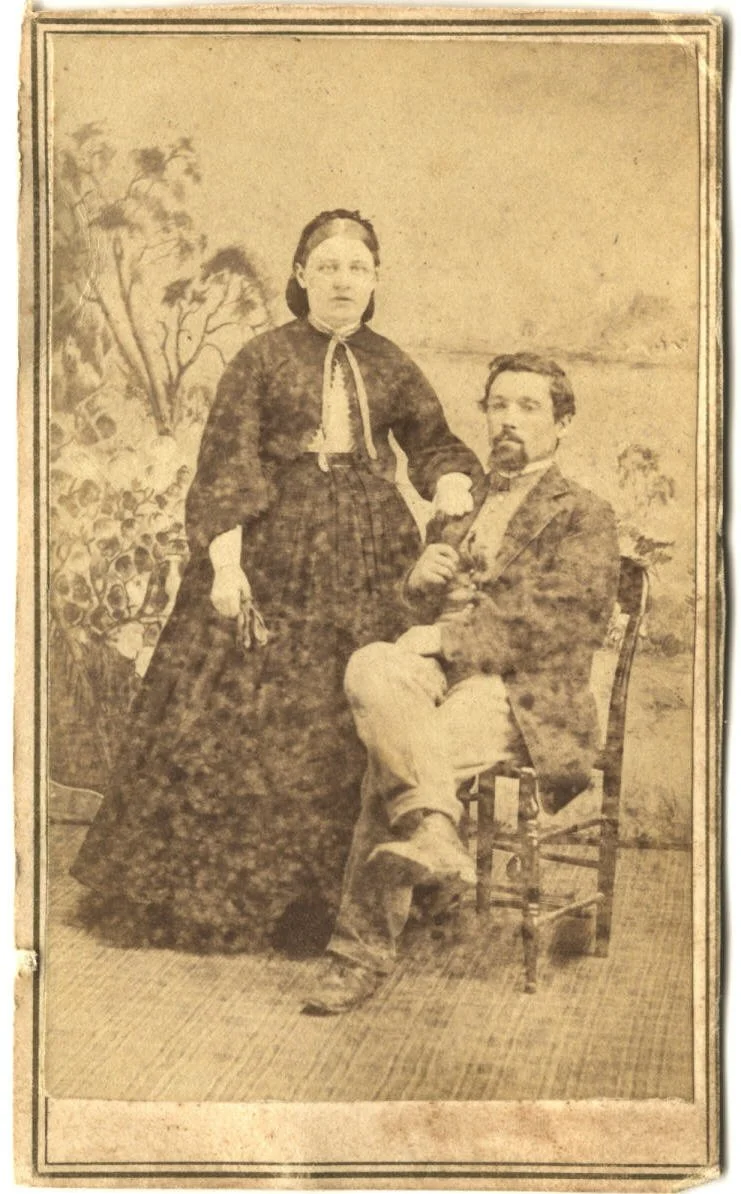
Erastus Guilford Bowe married Mary Elizabeth Hart
The history of the Washington Monument itself is both fascinating and fraught. In 1833, the Washington National Monument Society was formed with the goal of commemorating George Washington through a monumental structure. For more than a decade, the Society solicited designs and financial support before selecting architect Robert Mills’s ambitious design in 1845.[1]
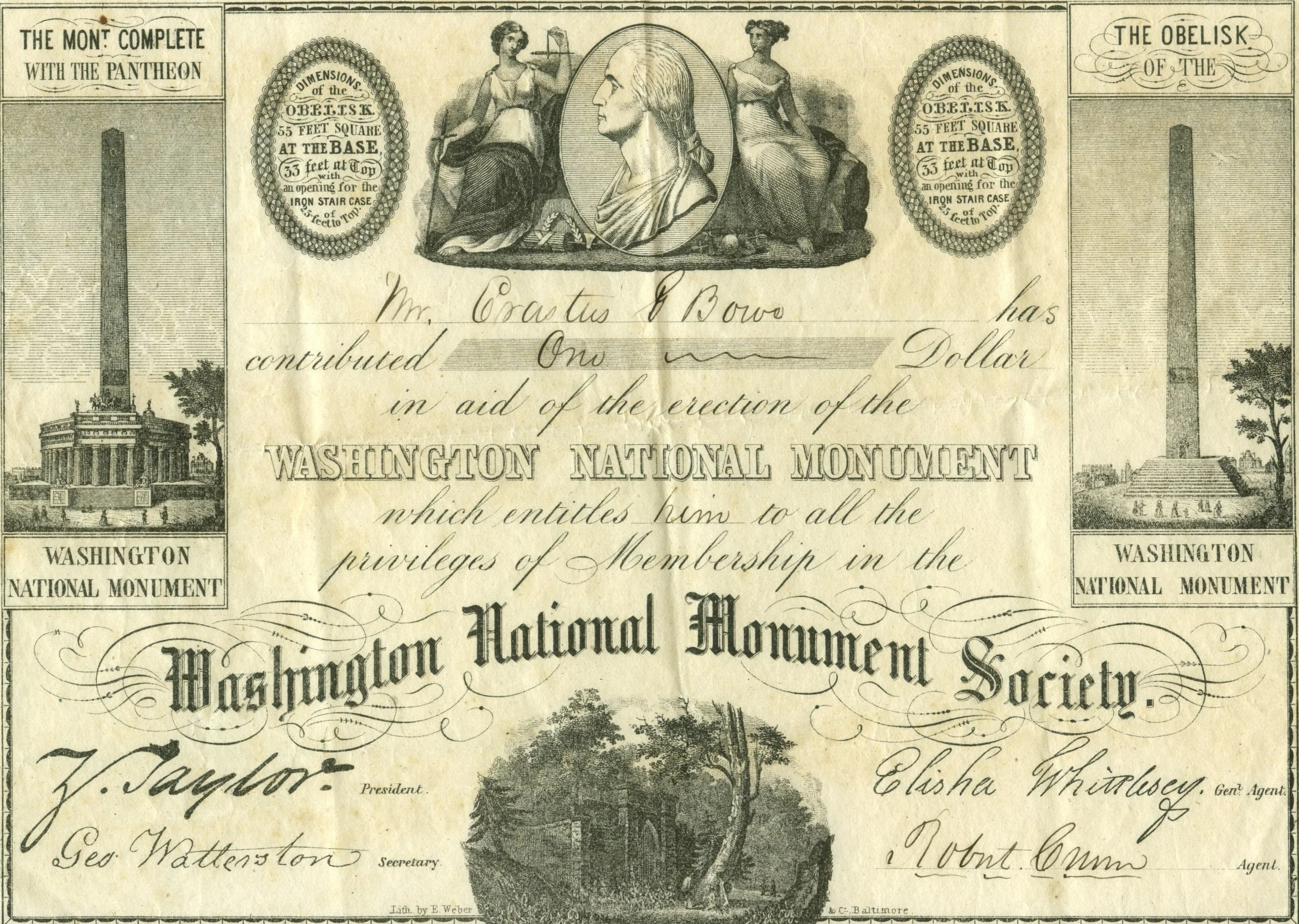
Erastus G. Bowe Contribution Certificate to Washington Monument
On July 4, 1848, the monument’s cornerstone was laid before a crowd estimated at more than 20,000 people. Mills’s original design was elaborate and far removed from the monument’s final appearance. Persistent fundraising challenges, combined with significant changes in the Society’s leadership, led to bankruptcy by 1854 and brought construction to a halt. The unfinished structure stood throughout the Civil War and was largely neglected until 1876, when Congress assumed responsibility for the project under the supervision of the U.S. Army Corps of Engineers. Structural concerns stemming from earlier cost-cutting measures had to be addressed before construction could resume.[2]
Design revisions continued as work progressed, largely driven by financial constraints, until the monument reached its present form in December 1884. Nearly fifty years after the original proposal, the Washington Monument was officially dedicated on February 21, 1885, the day before George Washington’s birthday.[3]
Subsequent decades brought further changes and preservation efforts. The original steam-powered elevator was replaced with an electric one in 1901. Responsibility for the monument transferred to the National Park Service in 1933, followed by a restoration project beginning in 1934. Additional major restoration campaigns took place in 1964, from 1998 to 2001, from 2011 to 2014 to address earthquake damage, and most recently from 2016 to 2019 to modernize the elevator system.[4]
The certificate recognizing Erastus Guilford Bowe’s donation entered the collection in 2014, accompanied by a brief description identifying it simply as a “Washington Monument Certificate.” That label, however, fails to capture the document’s broader significance. More than a decade later, as we continue to make the collection more accessible both internally and to outside researchers, a fuller picture has emerged—one that places Erastus’s modest contribution within the larger national effort to commemorate George Washington and preserve collective memory.
Family history often reveals its richest stories only after sustained engagement with records and collections. For researchers, historians, and curators alike, discoveries like this serve as powerful reminders that even seemingly ordinary documents can illuminate unexpected connections to the nation’s past.
Using AI to Glean Details from Your Family Documents
Are you using artificial intelligence (AI) to help with your historical research? Here’s how AI can help uncover valuable background information from a seemingly mundane item.
Are you using artificial intelligence (AI) to help with your historical research? Here’s how AI can help uncover valuable background information from a seemingly mundane item.
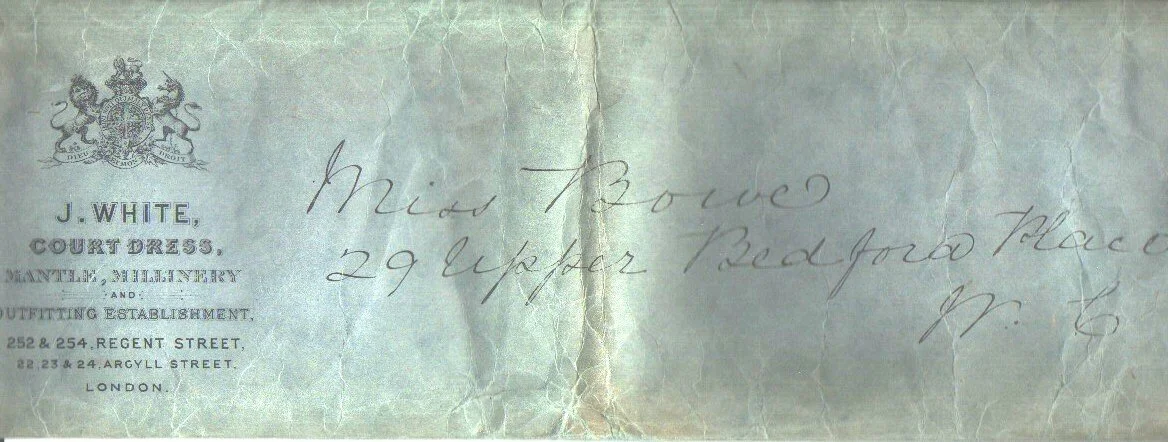
Image quality adjusted for clarity of text.
Transcription
[Printed - left side of envelope]:
J. White
Court Dress
Mantle, Millinery
and
outfitting establishment
252 & 254 Regent Street
22, 23 & 24 Argyll
London [England]
[A royal coat of arms appears above the printed text.]
[Handwritten - center to right side]:
Miss Bowe
29 Upper Bedford Place
W.C. [Western Central]
At first glance, an empty envelope with no postmark looks like a dud. But the return business name & address imprint, the address of the recipient, and even the make and design of the envelope can often provide useful information.
A scanned image of the envelope can be uploaded to an AI agent, such as ChatGPT with instructions to provide a description and analysis. AI’s perception of the paper used and even the font used in the imprint may establish a likely date range.
Address analysis can provide insight into the socio-economic status of the recipient based on the street and neighborhood. AI can also comb through resources to identify the business, its main products and services, and significant historical information associated with the business name or address.
Business Description & Address:
J. White operated a prestigious dressmaking and outfitting business, specializing in:
Court Dress: Elaborate formal wear required for presentation at the British Royal Court.
Mantles: Cloak-like garments worn as outerwear by fashionable women.
Millinery: Women's hats and hat-making services, an essential element of fashion at the time.
Regent Street and Argyll Street are in the West End of London, a prestigious shopping district historically associated with fashion, luxury goods, and elite clientele. It suggests that J. White catered to a high-society or upper-middle-class clientele, particularly women attending court, social functions, or needing formal attire.
The presence of the Royal Coat of Arms at the top of the envelope suggests royal patronage or an official supplier status, which was a significant mark of prestige.
Sources for J. White business information:
o The London Gazette (official public record of the British government) Includes advertisements and legal notices by J. White, Court Dressmaker, from the 1850s–1880s.
o Post Office London Directories (Kelly’s, Boyle’s Court Guide, etc.) List J. White, Court Dressmaker, at 252–254 Regent Street and Argyll Street, with some entries indicating royal or noble patronage.
o Regent Street: History and Architecture From the Survey of London, Vol. 32 and 33 (The Parish of St Marylebone, Part 2)
o The Queen’s London: A Pictorial and Descriptive Record of the Streets, Buildings, and Scenery of the Great Metropolis (Cassell & Co., 1896) Includes photographic documentation and mentions of fashion houses and outfitters, including those with royal warrants.
Upon request, the AI agent will also provide a list of references consulted or cited in the analysis. Follow-up research can confirm or deny the AI conclusions and the validity of the resources used.
The use of AI for background research saves precious time allowing human researchers to work on more complex problems. Or move on to the next item needing transcription or research!
So, an empty envelope can be much MORE than just an empty envelope! Rather than pass it by for a more alluring document, use it as a test of AI capabilities. Then decide for yourself if it’s a helpful research tool or not.
Artificial Intelligence Can Clarify Difficult Text and Provide “History Reveals”
When transcribing difficult to read documents, Artificial Intelligence (AI) can provide another “set of eyes” to review troublesome passages. After uploading a scanned image of the document, the AI agent, such as ChatGPT, can be instructed to analyze the handwriting and partial transcription. Then, it can be asked for its best recommendation for the unclear text. Afterward, AI can provide context if the meaning of the passage is still not apparent.
It is so satisfying when an illegible or confusing phrase in a document transcription suddenly becomes clear. Especially when the phrase sheds light on current events maybe occurring in the writer’s life or possibly around the world. These “History Reveals” provide “feel good” moments.
When transcribing difficult to read documents, Artificial Intelligence (AI) can provide another “set of eyes” to review troublesome passages. After uploading a scanned image of the document, the AI agent, such as ChatGPT, can be instructed to analyze the handwriting and partial transcription. Then, it can be asked for its best recommendation for the unclear text. Afterward, AI can provide context if the meaning of the passage is still not apparent.
Here’s an example:
A business letter of April 1887 involving foreign financing had the following sentence transcribed as: “Hope Bismark & Bolanger will not interfere in our success”

The two names did not match any known associates of the correspondents. And, despite the misspelling, Bismark was an obvious clue to Otto Van Bismarck. Bolanger, however, didn’t convey the same name recognition. Could the letter be referring to Bismarck, the German Chancellor?
The names Bismark and Bolanger were entered into ChatGPT along with the date April 1887. The agent was asked to research the input and provide the most likely connection between the names, the date, and any potential impact on international business at that time.
ChatGPT provided the following “History Reveal” previously unknown to the transcriber:
“In April 1887, the Schnaebele Affair—sparked by the arrest of a French police inspector by German authorities—nearly brought France and Germany to war. General Georges Boulanger became the symbol of French nationalism, while Chancellor Otto von Bismarck maneuvered to preserve his alliances. Newspapers in Europe and the United States warned of conflict, and financial markets wavered.[i] For American projects dependent on overseas investors, any disruption in Europe risked a sudden loss of capital and the collapse of enterprise.[ii]
Of course, other research tools could have been used to find the same information. However, AI delivered the answer within seconds and provided a list of references as well. This efficient research task added another “feel good” moment to the “History Reveal.”
What remains important, however, is what is known as the human loop. Meaning, in part, that while AI may seem accurate and present only factual information, it is critically important to verify what AI states. In this instance, the prompts included instructions to cite facts with known sources, which can then be looked up by a researcher to verify their accuracy. Without this step, AI hallucinations—made up information that it thinks is accurate—could be problematic if relied on.