
A Dollar That Helped Build a Monument: The Bowe Family and the Washington Monument
Family history often reveals its richest stories only after sustained engagement with records and collections. For researchers, historians, and curators alike, discoveries like this serve as powerful reminders that even seemingly ordinary documents can illuminate unexpected connections to the nation’s past.
As a trained museum curator, I’m accustomed to finding history in unexpected places. Early in my museum career, I focused on objects and how they shaped and reflected people’s lives. That curiosity was first sparked in antique stores—a place I spent a great deal of time while growing up in a family of collectors—where a single object could prompt questions about its use, ownership, and journey through time. When working with archives, such as those held by the American Pomeroys, that curiosity takes a different form. At the core of my professional background are history, primary-source research, and writing, a foundation that aligns closely with my museum training and directly informs my work today as the American Pomeroys’ Archivist.
Much of the work my team and I do happens behind the scenes, through projects that improve access to our own collections while opening new avenues of research for others studying the Pomeroy and allied family lines. Since last fall, we have been processing the Bowe Family Collection, connected to the great-great-grandparents of our organization’s founder. A significant portion of this work has focused on one individual in particular: James Edgar Bowe, whose travels took him from Ohio to California and back again, as well as overseas to England. His life story closely mirrors many defining themes of the mid-nineteenth-century United States, including westward expansion, the Gold Rush, and the development of banking and commerce. Once fully compiled and contextualized, his story will be shared in greater detail by our transcription and extraction specialist.
At the same time, intensive work on James Edgar Bowe’s materials prompted a broader re-examination of the entire collection. Like many archival accessions, the Bowe Family Collection arrived with limited original order, and earlier attempts at organization had left several groupings of documents only partially processed. The renewed research focus allowed the collection to be chronologically reorganized for the first time in years, revealing materials related to other members of the Bowe family. What emerged was a richer and more complex body of records documenting investments, land transactions, correspondence, and death records.
Among these materials, one document stood out—not as an investment record, but as an unexpected connection between the Bowe family and a national monument. Erastus Guilford Bowe, born circa 1818 (with records variously citing April 5, September 5, or occasionally 1817), spent most of his life in and around Tiffin, Seneca County, Ohio. Unlike his brother James Edgar Bowe, whose travels were far-reaching, Erastus remained close to home throughout his adult life.
On September 25, 1842, Erastus Guilford Bowe married Mary Elizabeth Hart (no known relation). He held a variety of occupations in Seneca County, primarily in Tiffin, and appears to have achieved a measure of financial stability through business and land dealings. Sometime between 1833 and 1854, Erastus donated one dollar to the Washington National Monument Society—an amount roughly equivalent to forty-two dollars today, and a meaningful contribution for the period.
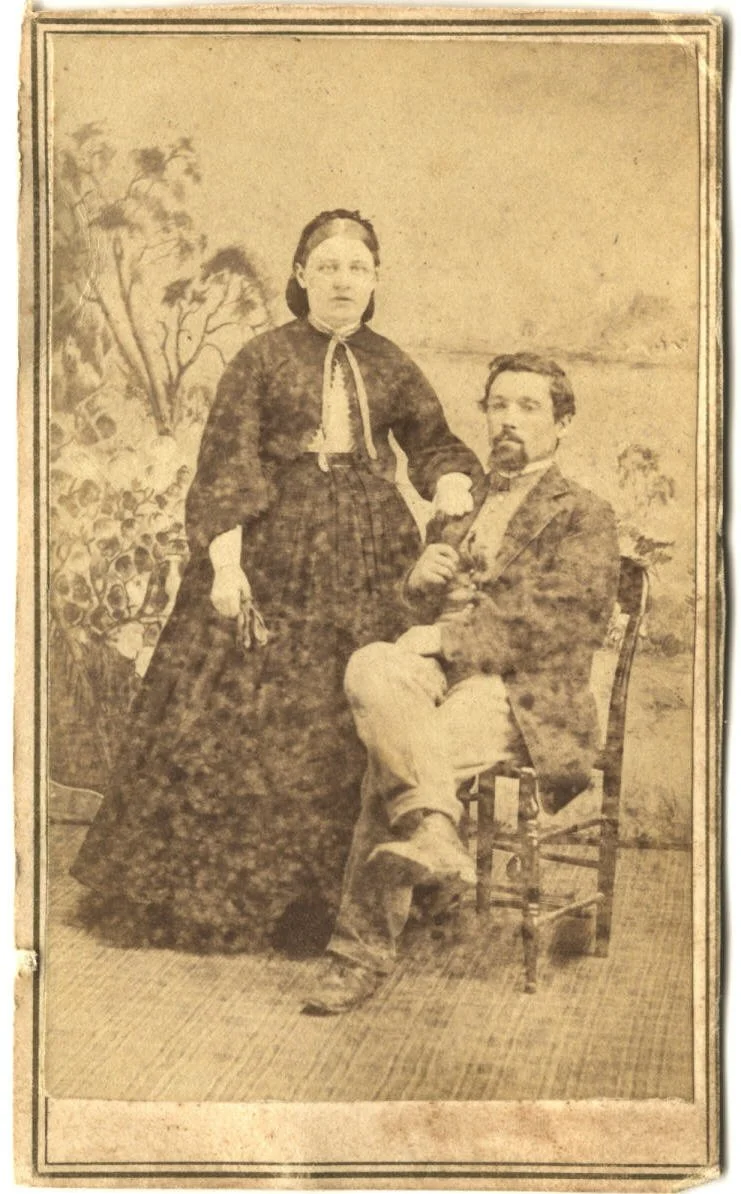
Erastus Guilford Bowe married Mary Elizabeth Hart
The history of the Washington Monument itself is both fascinating and fraught. In 1833, the Washington National Monument Society was formed with the goal of commemorating George Washington through a monumental structure. For more than a decade, the Society solicited designs and financial support before selecting architect Robert Mills’s ambitious design in 1845.[1]
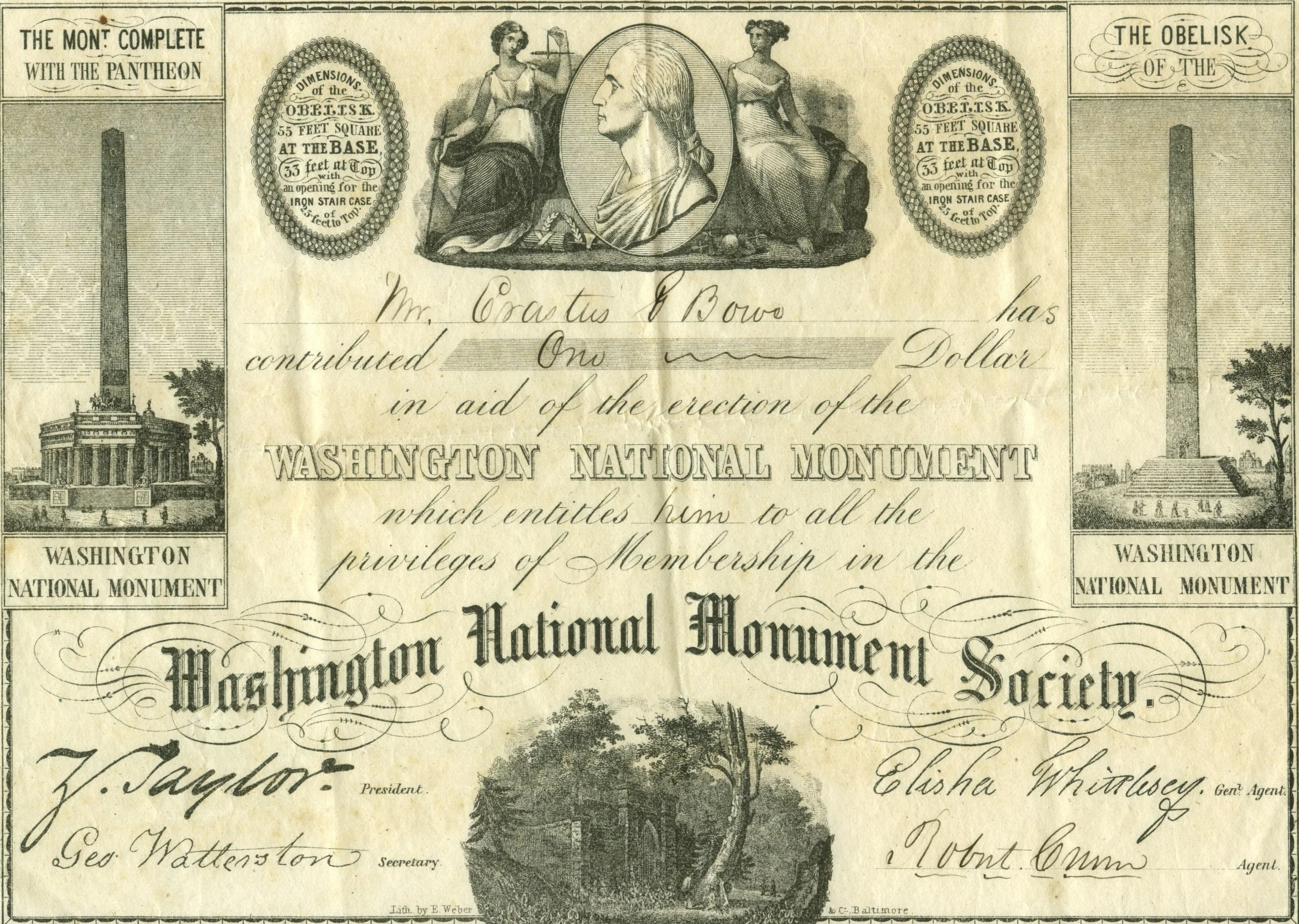
Erastus G. Bowe Contribution Certificate to Washington Monument
On July 4, 1848, the monument’s cornerstone was laid before a crowd estimated at more than 20,000 people. Mills’s original design was elaborate and far removed from the monument’s final appearance. Persistent fundraising challenges, combined with significant changes in the Society’s leadership, led to bankruptcy by 1854 and brought construction to a halt. The unfinished structure stood throughout the Civil War and was largely neglected until 1876, when Congress assumed responsibility for the project under the supervision of the U.S. Army Corps of Engineers. Structural concerns stemming from earlier cost-cutting measures had to be addressed before construction could resume.[2]
Design revisions continued as work progressed, largely driven by financial constraints, until the monument reached its present form in December 1884. Nearly fifty years after the original proposal, the Washington Monument was officially dedicated on February 21, 1885, the day before George Washington’s birthday.[3]
Subsequent decades brought further changes and preservation efforts. The original steam-powered elevator was replaced with an electric one in 1901. Responsibility for the monument transferred to the National Park Service in 1933, followed by a restoration project beginning in 1934. Additional major restoration campaigns took place in 1964, from 1998 to 2001, from 2011 to 2014 to address earthquake damage, and most recently from 2016 to 2019 to modernize the elevator system.[4]
The certificate recognizing Erastus Guilford Bowe’s donation entered the collection in 2014, accompanied by a brief description identifying it simply as a “Washington Monument Certificate.” That label, however, fails to capture the document’s broader significance. More than a decade later, as we continue to make the collection more accessible both internally and to outside researchers, a fuller picture has emerged—one that places Erastus’s modest contribution within the larger national effort to commemorate George Washington and preserve collective memory.
Family history often reveals its richest stories only after sustained engagement with records and collections. For researchers, historians, and curators alike, discoveries like this serve as powerful reminders that even seemingly ordinary documents can illuminate unexpected connections to the nation’s past.
Using AI to Glean Details from Your Family Documents
Are you using artificial intelligence (AI) to help with your historical research? Here’s how AI can help uncover valuable background information from a seemingly mundane item.
Are you using artificial intelligence (AI) to help with your historical research? Here’s how AI can help uncover valuable background information from a seemingly mundane item.
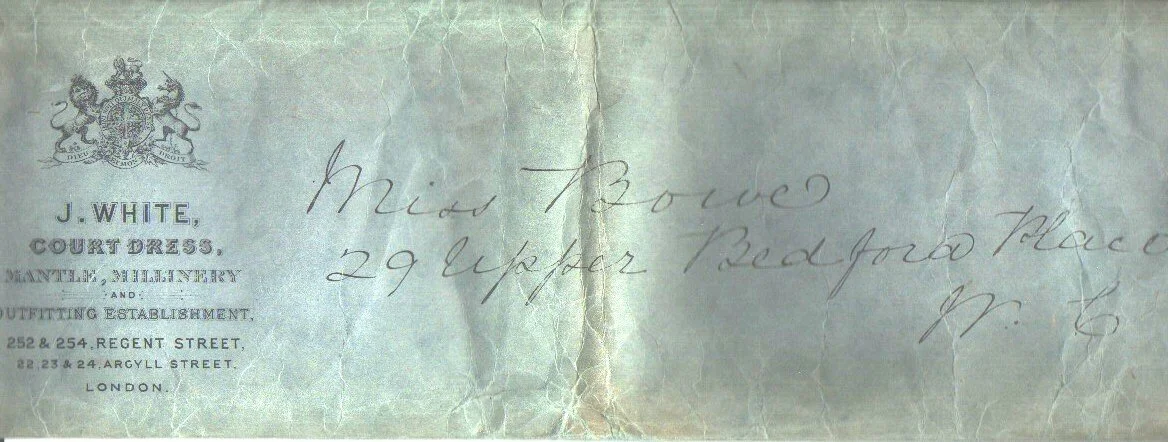
Image quality adjusted for clarity of text.
Transcription
[Printed - left side of envelope]:
J. White
Court Dress
Mantle, Millinery
and
outfitting establishment
252 & 254 Regent Street
22, 23 & 24 Argyll
London [England]
[A royal coat of arms appears above the printed text.]
[Handwritten - center to right side]:
Miss Bowe
29 Upper Bedford Place
W.C. [Western Central]
At first glance, an empty envelope with no postmark looks like a dud. But the return business name & address imprint, the address of the recipient, and even the make and design of the envelope can often provide useful information.
A scanned image of the envelope can be uploaded to an AI agent, such as ChatGPT with instructions to provide a description and analysis. AI’s perception of the paper used and even the font used in the imprint may establish a likely date range.
Address analysis can provide insight into the socio-economic status of the recipient based on the street and neighborhood. AI can also comb through resources to identify the business, its main products and services, and significant historical information associated with the business name or address.
Business Description & Address:
J. White operated a prestigious dressmaking and outfitting business, specializing in:
Court Dress: Elaborate formal wear required for presentation at the British Royal Court.
Mantles: Cloak-like garments worn as outerwear by fashionable women.
Millinery: Women's hats and hat-making services, an essential element of fashion at the time.
Regent Street and Argyll Street are in the West End of London, a prestigious shopping district historically associated with fashion, luxury goods, and elite clientele. It suggests that J. White catered to a high-society or upper-middle-class clientele, particularly women attending court, social functions, or needing formal attire.
The presence of the Royal Coat of Arms at the top of the envelope suggests royal patronage or an official supplier status, which was a significant mark of prestige.
Sources for J. White business information:
o The London Gazette (official public record of the British government) Includes advertisements and legal notices by J. White, Court Dressmaker, from the 1850s–1880s.
o Post Office London Directories (Kelly’s, Boyle’s Court Guide, etc.) List J. White, Court Dressmaker, at 252–254 Regent Street and Argyll Street, with some entries indicating royal or noble patronage.
o Regent Street: History and Architecture From the Survey of London, Vol. 32 and 33 (The Parish of St Marylebone, Part 2)
o The Queen’s London: A Pictorial and Descriptive Record of the Streets, Buildings, and Scenery of the Great Metropolis (Cassell & Co., 1896) Includes photographic documentation and mentions of fashion houses and outfitters, including those with royal warrants.
Upon request, the AI agent will also provide a list of references consulted or cited in the analysis. Follow-up research can confirm or deny the AI conclusions and the validity of the resources used.
The use of AI for background research saves precious time allowing human researchers to work on more complex problems. Or move on to the next item needing transcription or research!
So, an empty envelope can be much MORE than just an empty envelope! Rather than pass it by for a more alluring document, use it as a test of AI capabilities. Then decide for yourself if it’s a helpful research tool or not.
Down the Rabbit Hole: How a Pomeroy Resurfaced With a Revolutionary War Burial
The American Pomeroys is the sister organization to the William G. Pomeroy Foundation and so, from time to time, our work overlaps. This is especially true when your work actually stretches between the two: first as archivist and collections manager and second as a grant reviewer.
The American Pomeroys is the sister organization to the William G. Pomeroy Foundation and so, from time to time, our work overlaps. This is especially true when your work actually stretches between the two: first as archivist and collections manager and second as a grant reviewer. Since December 2024 I have been fortunate to be one of the reviewers for the Patriot Burials® historic marker program, a partnership between the Sons of the American Revolution and the foundation to recognize and preserve the memory of Revolutionary War patriots. For more information on this program, check out the main description for this program here and also dig into the Foundation’s Marker Map to see where these markers are located.
So how does a grant overlap with the work of the American Pomeroys? By happenstance really. While reviewing a marker for the Draper Hill Cemetery in Westford, Otsego County, NY, I look at the Find a Grave page for the proposed patriots. For Draper Hill, that included Edward Wright. As soon as I started reviewing his profile his spouse’s name popped up: Chloe Pomeroy Wright. Now, this isn’t something I was expecting and so, down a rabbit hole I went. For anyone who researches for fun or professionally like me, rabbit holes aren’t always a bad thing. Sometimes they lead to incredible unexpected findings or turn up a little-known tidbit of history for trivia night.
Chloe Pomeroy was born on April 25, 1753, to Samuel Pomeroy and Chloe Kingsley Pomeroy, in Southampton, Hampshire County, Massachusetts Bay Colony. [1] Around May 25, 1772, she married Edward Wright, Jr., son of Edward Wright, in Chester, Hampshire County, Massachusetts Bay Colony; unfortunately, the identity of Edward’s mother is not documented in existing genealogical records.[2]
Very little is documented about Chloe’s life, and the surviving records are sparse. In October 1785, she is named in her father’s will, receiving five shillings.[3] In 1790, while she is not specifically named in the federal census, circumstantial evidence suggests she was living in Chester with Edward, where they had married.[4]
By 1800, Edward appears in the federal census living in Worcester, New York, followed by Westford, New York, in 1810 and 1820.[5] Although spouses were not listed by name in these early censuses, it is reasonable to infer that Chloe resided with Edward during these years. Chloe died in 1820, though her exact date of death is unknown.[6] Edward outlived her by approximately eleven years, dying on May 28, 1831.[7]
While the names of Edward and Chloe’s children are recorded in the American Pomeroys genealogy database, they are not enumerated here, as the focus of this post is Chloe herself and the unexpected rediscovery of her story.
For the Patriots Burial program, we typically rely on two key elements to include a patriot’s name on a maker: can we prove their service (civil or military) and is their burial stone original? The former takes a bit of a deeper dive into military history while the latter is usually done visually by Find a Grave or through burial records if they exist. Both Edward and Chloe’s stones are original and sparsely decorated. Chloe’s stone is a simple field stone with her name and year of death shallowly engraved. There’s a bit more writing in between, but it’s not completely legible. The stone is considered well-preserved as most stones of this age and material aren’t intact or so badly weathered they’re basically blank. Edward’s stone is an example of one that’s weathered, but with being partially buried is still legible (his name is a bit shallow, but visible in the Find a Grave images.
Ultimately, the documentation submitted with the marker application successfully demonstrated Edward Wright’s Revolutionary War service—notably, as a member of Col. Seth Pomeroy’s Regiment—along with the service of three additional individuals identified by the local organization working in partnership with the Empire State Society of the Sons of the American Revolution.[8] As a result, in early 2026, a blue-and-red Patriot Burials® marker will be placed at Draper Hill Cemetery, drawing attention both to these four patriots and to the cemetery itself.
While Chloe Pomeroy Wright’s gravestone does not record her maiden name, the marker application process, combined with existing genealogical documentation and a bit of “rabbit hole” research, has ensured that her name and story—however fragmentary—are now better documented and preserved for future generations.
Remember: if you are not preserving your family’s history, no one else may be either. Document your research, preserve vital records and family photographs, and share your findings with relatives so that they can be passed down from one generation to the next.
[1] "Massachusetts, Births and Christenings, 1639-1915", database, FamilySearch (https://familysearch.org/ark:/61903/1:1:V5NS-HPX : 14 January 2020), Chloe Pomeroy, 1753.
[2] "Massachusetts, State Vital Records, 1638-1927", database with images, FamilySearch (https://www.familysearch.org/ark:/61903/1:1:FCWG-NZ6 : 28 December 2022), Cloe Pomeroy in entry for Edward Wright, 1772.
[3]Hampshire County, MA: Probate File Papers, 1660-1889. Online database. AmericanAncestors.org. New England Historic Genealogical Society, 2016, 2017. (From records supplied by the Massachusetts Supreme Judicial Court Archives and the Hampshire County Court. Digitized mages provided by FamilySearch.org)
https://www.americanancestors.org/DB1653/rd/39977/116-31-co1/1044372420
[4] The National Archives in Washington, DC; Washington, DC; First Census of the United States, 1790.; Year: 1790; Census Place: Chester, Hampshire, Massachusetts; Series: M637; Roll: 4; Page: 139; Family History Library Film: 0568144.
[5] Year: 1800; Census Place: Worcester, Otsego, New York; Series: M32; Roll: 25; Page: 668; Image: 93; Family History Library Film: 193713.
Year: 1810; Census Place: Westford, Otsego, New York; Roll: 34; Page: 240; Image: Nym252_34-0127; Family History Library Film Roll: 0181388.
Fourth Census of the United States, 1820; Census Place: Westford, Otsego, New York; Page: 34; NARA Roll: M33_74; Image: 46.
[6] “Chloe Pomeroy Wright (1753-1820) - Find a Grave...” Find a Grave. Accessed January 6, 2026. https://www.findagrave.com/memorial/64696501/chloe-wright.
[7] “Edward Wright Jr. (1748-1831) - Find a Grave...” Find a Grave. Accessed January 6, 2026. https://www.findagrave.com/memorial/5381986/edward-wright.
[8]Massachusetts Soldiers and Sailors of the Revolutionary War: A Compilation From the Archives, vol. 17 (Boston, Massachusetts: Secretary of the Commonwealth, 1908), 925.
Family Treasures and the Stories They Tell
Many changes at the American Pomeroys and William G. Pomeroy Foundation happened in late 2025. One major event was the retirement of Susan Hughes, who in addition to her role with the American Pomeroys, took on the mantle of Lead Historian for the Foundation’s historic marker team, which she retired from on December 31. To honor all of Susan’s accomplishments with the American Pomeroys and Foundation, we are re-publishing this article on preserving, researching, and presenting family history.
In February 2014 I joined the American Pomeroy Historic Genealogical Association as the new Director. Since coming to Upstate New York 14 year ago, I’ve taught many workshops to diverse audiences. One problem I’ve seen in many archives is how to interpret those non-traditional materials found in collections. The following is adapted from a workshop I developed in answer to that problem. I hope it gives you some insight into your personal collections; not only how to make use of them today, but how to make them speak to future generations.
Family history is more than just birth, marriage, and death dates – it’s the story of your family’s interactions with the community. Sources for these histories, provided by written documentation as well as oral tradition, are valuable to family members, historians, and the community. The records used to research family history are an important part of our documentary heritage providing a direct link to our common past. Your family’s history lives in documents like photographs, letters, legal and financial papers, artistic works, news-clippings, home movies, diaries, and journals. All those materials that document interaction - and sometimes clutter our homes and offices - are the stuff of history.
Why document? Our story and that of our ancestors is the story of our community, our country, and our world. That story becomes history when it is organized and preserved for future generations. Documentation is the process of identifying, collecting, and making available records of historical value; it supplies researchers with the raw materials of history and ensures a more comprehensive historical record when groups and topics out of the mainstream are included. The decisions we make in the present and will make in the future depend on our understanding – or misunderstanding – of the past.
Here are some underused but invaluable resources for family history:
Recipes and cookbooks
One genealogy magazine stated, “Food equals nostalgia” – how true! Culinary history has become a rich resource used by social historians to understand local, regional, and national history. The sharing and passing down of recipes tie us to our family, our ethnicity and to changes in American culture. Ingredients can help date a recipe. For example, processed foods date primarily from the 20th century. Frozen foods weren’t available commercially until 1924, although canned foods were produced in England as early as 1815.
Quilts and textiles
Every quilt has a story that should be told. Many times, they were used to record events such as births or marriages, but the fabrics and patterns can give us clues as well. Fabrics can indicate the owner’s economic situation: small pieces sewn together to make a larger quilt patch may indicate a lack of funds so every scarp was saved, while large uncut patches of fabric or fancy paisleys may show a woman who had the means to purchase fabric specifically for quilt-making. When wars ended, many quilters used the fabrics from uniforms of returning and lost soldiers to make quilts. Signature quilts were made as gifts for prominent community members, such as clergy. A census record in thread! Clothing fashions also responded to current events – women’s clothing became less structured and skirts shorter as more women worked outside the home; military styles in both men’s and women’s dress show up during and after wartime.
Artifacts such as vintage tools, toys, artwork, etc.
Start investigating the stories behind your family treasures. How did it come into your possession and who owned it originally? Are there stories associated with it? It seems like nothing evokes memories and conversation like old toys! Toys, like the textiles mentioned earlier, are reflections of popular culture, trends, and fashions. And don’t forget about those professional tools – not only who used them, but how they were used. Finally, commemorative items like medals, ribbons or pins reflect the ways in which we choose to memorialize special events. The fact that the item was saved shows the importance attached to it by its owner. Notice, though, that these items are not as personalized as similar items are today, which makes recording to whom they belonged and why even more imperative.
Oral histories and "family lore"
The artifact we’ve just discussed can be our touchstones: they evoke memories and bring forth stories. Oral history is a method of gathering and preserving memories that relies on the spoken word. It is both the oldest type of historical inquiry, predating the written word, and one of the most modern, now using digital technologies. It presents the opportunity for those people “hidden” from history to have their voices heard and can provide new insights that challenge our view of the past. And don’t dismiss family lore! There’s often a kernel of truth to be found in it, it’s just gotten embellished over the years.
Putting it All to Work
How do we document using these non-written sources? Documentation often involves creating new records to help fill gaps in the historical record. Think who, what, when, where and why? Standardized documentation forms are very helpful. When encountering a group or collection of items, be aware of items stored together: sometimes one item gives a clue about another item stored with it, similar to what archivists call original order.
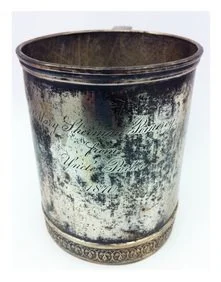
The Pomeroy Collection holds the petite silver cup shown in the photo. It came into the collection in2002 from an estate auction but, unfortunately, we had no one to interview regarding its origins and the people whose names are engraved on it. Additionally, an elegant silver cup, richly detailed and marked “English Sterling” on the bottom, seems somewhat out of place for rural Cortland County in the mid-Nineteenth Century. Would one have easy access to a purveyor of such an extravagant item?
We started with what we knew: we found a Mary Sherman Pomeroy born 1870 in Brooklyn, NY. Her father was Julius Pomeroy and her mother was Frances Elvena Sherman. Frances Elvena was born and died in Homer, Cortland County, New York - consistent with the location of the estate. Furthermore, Frances had a brother named Porter, also born in Homer. That’s our Uncle Porter! But Mary was born in Brooklyn and, as it turns out, that’s where her uncle, Porter Sherman, died. Living in Brooklyn around 1870 would certainly give more ready access to shops in New York City selling merchandise like an engraved silver piece.
Now we had who - Mary Sherman Pomeroy and her uncle Porter Sherman, what - an elegantly engraved sterling silver baby cup, when - 1870, where - Borough of Brooklyn, New York City, and the Village of Homer. But we needed why: if Mary was born in Brooklyn in 1870 and Uncle Porter died in Brooklyn in 1901, why did this cup end up in Homer in 2002? An investigation of vital records, census data, court records, and other sources helped us piece together the answer.
In 1858, Frances Elvena Pomeroy of Homer, Cortland County, married Julius Pomeroy, a young lawyer living with a relative in Brooklyn. Elvena, as she was known, had an older brother named Porter living in Brooklyn at the same time. Elvena and Julius settled in Brooklyn and baby Mary was born in 1870. Unfortunately, probate records show that Julius died in 1877, leaving Elvena and five children. Soon after, Elvena moved back to Homer to raise her children in the house she and her brothers had inherited from their father in 1869, apparently taking the silver baby cup with the rest of the family’s possessions. Porter remained in Brooklyn until his death in 1901. The recipient of the little silver cup, Mary, married a young man from Homer named Lewis Tuthill in 1895 and moved to Minneapolis, Minnesota where she died in 1908 at age 38, having no children; she was interred at Glenwood Cemetery in Homer. Elvena outlived both Mary and Porter, dying in 1913.
A little silver cup unveils a family’s history. Who could have guessed it would end up in the possession of a cousin (fourth cousin twice removed, to be precise) in such a serendipitous manner as being spotted at an estate sale by someone who knew Bill Pomeroy’s passion for family history? Mary Sherman Pomeroy Tuthill has told us her story.