
Using AI to Glean Details from Your Family Documents
Are you using artificial intelligence (AI) to help with your historical research? Here’s how AI can help uncover valuable background information from a seemingly mundane item.
Are you using artificial intelligence (AI) to help with your historical research? Here’s how AI can help uncover valuable background information from a seemingly mundane item.
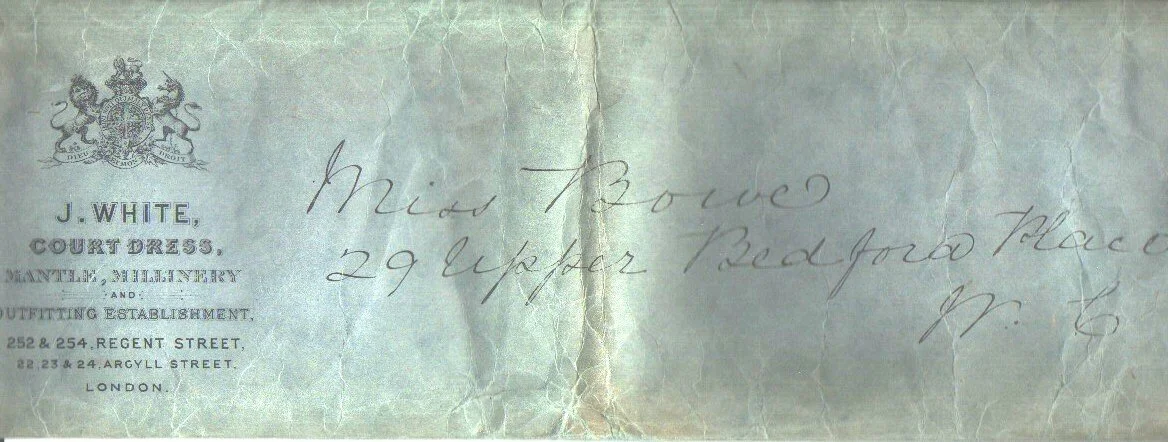
Image quality adjusted for clarity of text.
Transcription
[Printed - left side of envelope]:
J. White
Court Dress
Mantle, Millinery
and
outfitting establishment
252 & 254 Regent Street
22, 23 & 24 Argyll
London [England]
[A royal coat of arms appears above the printed text.]
[Handwritten - center to right side]:
Miss Bowe
29 Upper Bedford Place
W.C. [Western Central]
At first glance, an empty envelope with no postmark looks like a dud. But the return business name & address imprint, the address of the recipient, and even the make and design of the envelope can often provide useful information.
A scanned image of the envelope can be uploaded to an AI agent, such as ChatGPT with instructions to provide a description and analysis. AI’s perception of the paper used and even the font used in the imprint may establish a likely date range.
Address analysis can provide insight into the socio-economic status of the recipient based on the street and neighborhood. AI can also comb through resources to identify the business, its main products and services, and significant historical information associated with the business name or address.
Business Description & Address:
J. White operated a prestigious dressmaking and outfitting business, specializing in:
Court Dress: Elaborate formal wear required for presentation at the British Royal Court.
Mantles: Cloak-like garments worn as outerwear by fashionable women.
Millinery: Women's hats and hat-making services, an essential element of fashion at the time.
Regent Street and Argyll Street are in the West End of London, a prestigious shopping district historically associated with fashion, luxury goods, and elite clientele. It suggests that J. White catered to a high-society or upper-middle-class clientele, particularly women attending court, social functions, or needing formal attire.
The presence of the Royal Coat of Arms at the top of the envelope suggests royal patronage or an official supplier status, which was a significant mark of prestige.
Sources for J. White business information:
o The London Gazette (official public record of the British government) Includes advertisements and legal notices by J. White, Court Dressmaker, from the 1850s–1880s.
o Post Office London Directories (Kelly’s, Boyle’s Court Guide, etc.) List J. White, Court Dressmaker, at 252–254 Regent Street and Argyll Street, with some entries indicating royal or noble patronage.
o Regent Street: History and Architecture From the Survey of London, Vol. 32 and 33 (The Parish of St Marylebone, Part 2)
o The Queen’s London: A Pictorial and Descriptive Record of the Streets, Buildings, and Scenery of the Great Metropolis (Cassell & Co., 1896) Includes photographic documentation and mentions of fashion houses and outfitters, including those with royal warrants.
Upon request, the AI agent will also provide a list of references consulted or cited in the analysis. Follow-up research can confirm or deny the AI conclusions and the validity of the resources used.
The use of AI for background research saves precious time allowing human researchers to work on more complex problems. Or move on to the next item needing transcription or research!
So, an empty envelope can be much MORE than just an empty envelope! Rather than pass it by for a more alluring document, use it as a test of AI capabilities. Then decide for yourself if it’s a helpful research tool or not.
Artificial Intelligence Can Clarify Difficult Text and Provide “History Reveals”
When transcribing difficult to read documents, Artificial Intelligence (AI) can provide another “set of eyes” to review troublesome passages. After uploading a scanned image of the document, the AI agent, such as ChatGPT, can be instructed to analyze the handwriting and partial transcription. Then, it can be asked for its best recommendation for the unclear text. Afterward, AI can provide context if the meaning of the passage is still not apparent.
It is so satisfying when an illegible or confusing phrase in a document transcription suddenly becomes clear. Especially when the phrase sheds light on current events maybe occurring in the writer’s life or possibly around the world. These “History Reveals” provide “feel good” moments.
When transcribing difficult to read documents, Artificial Intelligence (AI) can provide another “set of eyes” to review troublesome passages. After uploading a scanned image of the document, the AI agent, such as ChatGPT, can be instructed to analyze the handwriting and partial transcription. Then, it can be asked for its best recommendation for the unclear text. Afterward, AI can provide context if the meaning of the passage is still not apparent.
Here’s an example:
A business letter of April 1887 involving foreign financing had the following sentence transcribed as: “Hope Bismark & Bolanger will not interfere in our success”

The two names did not match any known associates of the correspondents. And, despite the misspelling, Bismark was an obvious clue to Otto Van Bismarck. Bolanger, however, didn’t convey the same name recognition. Could the letter be referring to Bismarck, the German Chancellor?
The names Bismark and Bolanger were entered into ChatGPT along with the date April 1887. The agent was asked to research the input and provide the most likely connection between the names, the date, and any potential impact on international business at that time.
ChatGPT provided the following “History Reveal” previously unknown to the transcriber:
“In April 1887, the Schnaebele Affair—sparked by the arrest of a French police inspector by German authorities—nearly brought France and Germany to war. General Georges Boulanger became the symbol of French nationalism, while Chancellor Otto von Bismarck maneuvered to preserve his alliances. Newspapers in Europe and the United States warned of conflict, and financial markets wavered.[i] For American projects dependent on overseas investors, any disruption in Europe risked a sudden loss of capital and the collapse of enterprise.[ii]
Of course, other research tools could have been used to find the same information. However, AI delivered the answer within seconds and provided a list of references as well. This efficient research task added another “feel good” moment to the “History Reveal.”
What remains important, however, is what is known as the human loop. Meaning, in part, that while AI may seem accurate and present only factual information, it is critically important to verify what AI states. In this instance, the prompts included instructions to cite facts with known sources, which can then be looked up by a researcher to verify their accuracy. Without this step, AI hallucinations—made up information that it thinks is accurate—could be problematic if relied on.